
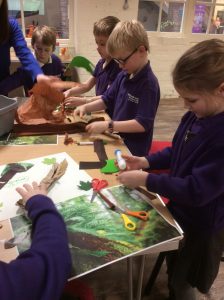
 Groups of children from 2 local schools (Priory Community Secondary in Worle and St Andrew’s Primary in Congresbury) have spent the past year taking part in a project to explore biodiversity and changing climates across history. Children from Reception to year 9 took part in nature based activities and 2 groups had the chance to decide ‘legacy actions’ to inspire others and make a positive change for the future. This project was funded through a grant from Arts Council England via Museums Development South West.
St Andrew’s Primary, Congresbury
Museum Session – A class of children (Year 3) visited the museum to take part in a session all about biodiversity and how fossils can tell us about North Somerset’s past climates, from desert and rainforest to sub-tropical seas and ice sheets. They explored plant fossils, tree fossils and coral, before making their own scrap collages of different climates.
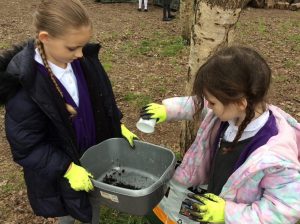 Nature Day – The whole school then had the chance to take part in a nature day back at the school site, where children could explore the biodiversity present in their own grounds. Children aged from reception to Year 6 got involved with leaf spotting, tree rubbing and nature art. This was also supported by Yeo Vale Forest School to explore different habitats and what everyday items come from nature.
Legacy Actions – These learning activities were then followed up with the Year 3 class through the opportunity to decide their own ‘legacy actions’ to make a positive change for the future. The children were able to suggest a huge mix of actions that were then narrowed down and presented back to them to vote on the final 3 choices.
Their first choice was to do some planting in the school grounds. The school is very fortunate to have a wide variety of trees and outdoor green space, but after undertaking a habitat survey it was decided that some more low coverage would be good. The class spent an afternoon planting ferns, as these are a type of plant that they had explored in fossil form. To go alongside the ferns and create a small prehistoric nature learning area, there are also a few fossil ammonite sculptures.
Their second choice was to give some love to an area of the school grounds that they wanted others to use more; the pond area. This space is a learning opportunity that needed a fresh look, so the children spent an afternoon painting the surrounding fence to draw attention to the area.
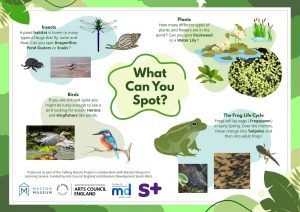 In order to encourage more outdoor learning about biodiversity and fossil life, 4 new signboards were created, 2 for the pond area and 2 for the prehistoric nature area. The location for the prehistoric nature area was chosen specially to tie in with the new outdoor classroom, a gazebo structure that was installed at the end of the school year. The ferns and fossil sculptures are placed next to the gazebo with 2 signboards on the side of it, one exploring ‘Ancient Nature’ and another ‘What Can You Spot?’ board.
Their third choice was to inspire others and ask the people in charge to make changes through a poster design and letter writing session. Their letters and posters have been sent to their MP Tessa Munt.
Priory Community School, Worle
Museum Session – Students from the Science Club and the Eco Club visited the museum to take part in a session all about biodiversity and how fossils can tell us about North Somerset’s past climates, from desert and rainforest to sub-tropical seas and ice sheets. They explored plant fossils, tree fossils and coral, before making their own scrap collages of different climates. They also took part in some activities that visually mapped out the warming present climate of the Earth now and a game that explored some of the factors that have thrown the climate out of balance and into crisis.
Nature Day – Selected groups of students from Year 7 to Year 9 then had the chance to take part in a nature day back at the school site, where children could explore the biodiversity present in their own grounds. This was supported by Yeo Vale Forest School to explore different habitats and what everyday items come from nature.
Legacy Actions – These learning activities were then followed up with the Science Club and Eco Club through the opportunity to decide their own ‘legacy actions’ to make a positive change for the future. The children were able to suggest a huge mix of actions that were then narrowed down and presented back to them to vote on the final choices.
The club members felt that whilst they were passionate and knowledgeable about climate change, there was a lack of wider interest from the other students across the school. This was something that they wanted to change and they felt that the most effective way to gather interest would be to hold a competition. They decided to have an art competition across the school to tie in with Science Month; the theme was biodiversity and climate change.
 In order to promote this competition, an event was held one lunch time where a stall was put up in the cafeteria, manned by club members who shared information with other students. The club members felt that it was very important to have something to encourage others to stop by, so there were freebies in the form of chocolates and climate themed stickers to draw people in. Visitors to the stall could pick a sticker or chocolate to take away after they had chatted to the club members about the competition and freebies were closely guarded to ensure they were only distributed after a chat had taken place. Some club members were so keen on this that visitors to the stall had to pass a memory test to recount competition details before being allowed to take a freebie! At the close of the lunch break, the stall had had a huge number of visitors and all 300 stickers and chocolates had gone.
There was a wide range of entries from across all the year groups, with posters, drawings and leaflets. One winner from each year group was chosen to receive a prize of a goodie bag including a book voucher, science themed kit and seeds.
As well as holding a competition, the other legacy action that the club members decided upon was to make some improvements to the nature area in the school grounds that has been recently set up to facilitate nature learning. Following suggestions from club members and a discussion with the staff member that looks after the area, it was decided that the most beneficial action would be to install a water butt and watering system, as they had been struggling to keep the plants watered due to the location of the area.
It was also decided that in order to encourage more outdoor learning in the nature area, 2 new signboards were created, exploring ‘Ancient Nature’ and ‘Plant Life’.
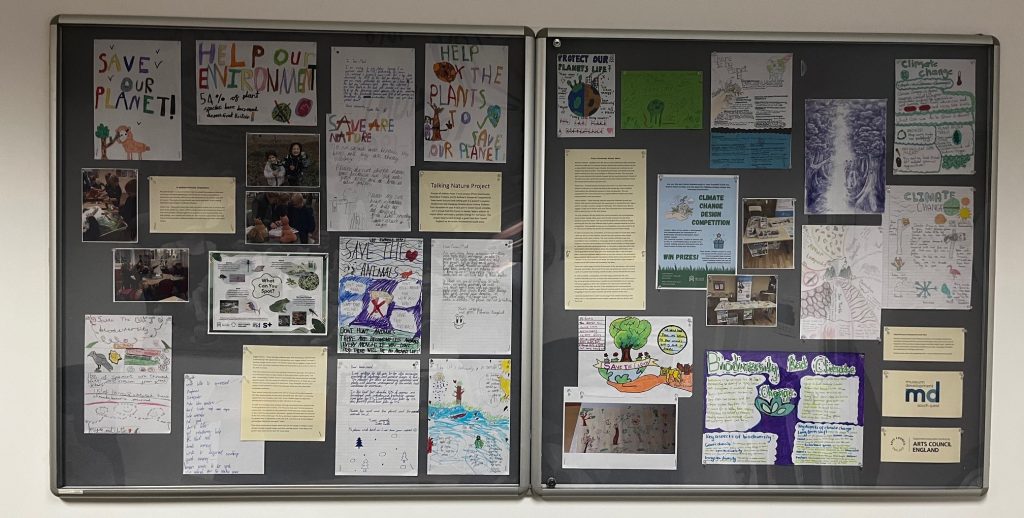
As a result of taking part in this project, children reported that they felt they had more impact on the climate crisis on an individual level and had the ability to make positive changes. Information about this project including letters, posters and various competition entries are now on display in the Schools and Community Display board in Weston Museum.
 About Museum Development South West
Museum Development South West are museum and heritage development specialists working with the museum and heritage sector in the south west of England to effect positive, lasting change and deliver public value. Together we create opportunities which build confidence and skills, encourage innovation, and celebrate our heritage and culture.
Find out more about the programme here: www.southwestmuseums.org.uk